
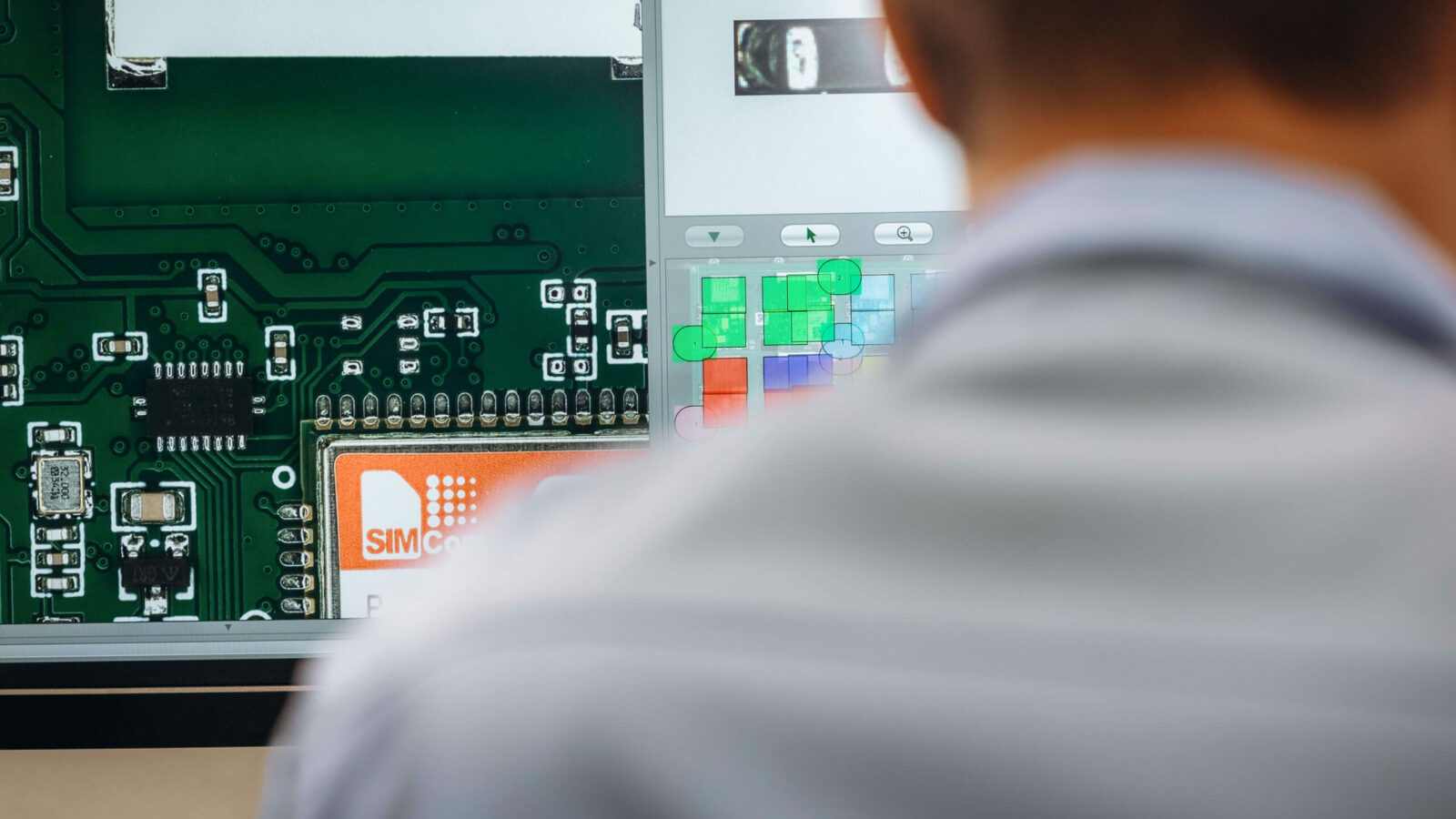
After assembly and AOI inspection, the board is put together correctly. But does the device work? That is what functional testing answers: we power it up, load the software and check the interfaces, communication and functions exactly as they will be used. At Convel, programming and testing are part of the production process, not an extra service. Every unit is checked, the test result is recorded in the system, and the device leaves us ready to work, not just ready to sell.
Device programming on the line
After assembly, the device receives its software: production firmware, configuration, serial number and, where needed, keys, certificates or calibration data. We do this at programming stations, through a connector on the board or a wireless interface, following a procedure agreed with the customer. If the firmware was written here, the production version is ready together with the hardware; if you supply your own, we integrate it with our station. New versions are rolled out in production without stopping the run. We write about the software itself on the page firmware for devices.
Functional testing: what we check
The test procedure is built from the device specification and is different for a GPS tracker and for an industrial controller. A typical scope covers:
- power: current draw in active and sleep states, battery charging, protection circuits,
- interfaces: USB, RS-485, CAN, digital and analogue inputs and outputs, sensors,
- communication: Bluetooth, Wi-Fi, LTE, GPS – establishing a connection, signal level, data exchange,
- user functions: display, keypad, indicators, relays, everything the user will see or hear,
- calibration of sensors and measurement paths, if the device requires it.
The result for every unit (the actual values, not just “OK”) is recorded in the production system and tied to the serial number. If a complaint comes back a year later, we know what parameters the device had on the day it was produced.
Test fixtures for your product
When production is set up, we design a test fixture: a rig that connects to the device, powers it, simulates signals and reads the responses. For short runs this may be a set of cables and a script; for large ones, a dedicated adapter that cuts the test of a single unit down to the necessary minimum. The cost of the fixture is part of the start-up and quickly pays for itself in repeatability and testing speed. When we design the board, we plan test points from the start; for external designs we suggest what to add during the documentation review.
Testing and quality control
Functional testing is the last stage of inspection, after AOI inspection and visual inspection. It catches what optics will not see: a damaged component that looks fine, a wrong value, a communication problem. Devices that fail the test go to analysis, not to a quick fix – we check whether the problem affects the whole batch or the design.
What happens next
After programming and testing, the device goes on to enclosure assembly or, if the enclosure is already fitted, to final assembly: labels, serial numbers and packaging. What leaves us can be a product ready to ship to the end customer.
Frequently asked questions about testing
Do you test every unit or a sample?
Every unit. The result is recorded individually and linked to the serial number.
Who prepares the test procedure?
We do, based on the customer’s specification, and we agree it before the run starts. If you have your own procedure, we implement it on our fixture.
Can I receive the test results?
Yes, as a batch report or as a data export into your system, as agreed.
Will you load my firmware?
Yes. You supply the file and the instructions, and we integrate programming into the production station.
Ask about this service
Send us your project documentation and we will prepare a quote together with a proposed production schedule.
Request a quote View other services