
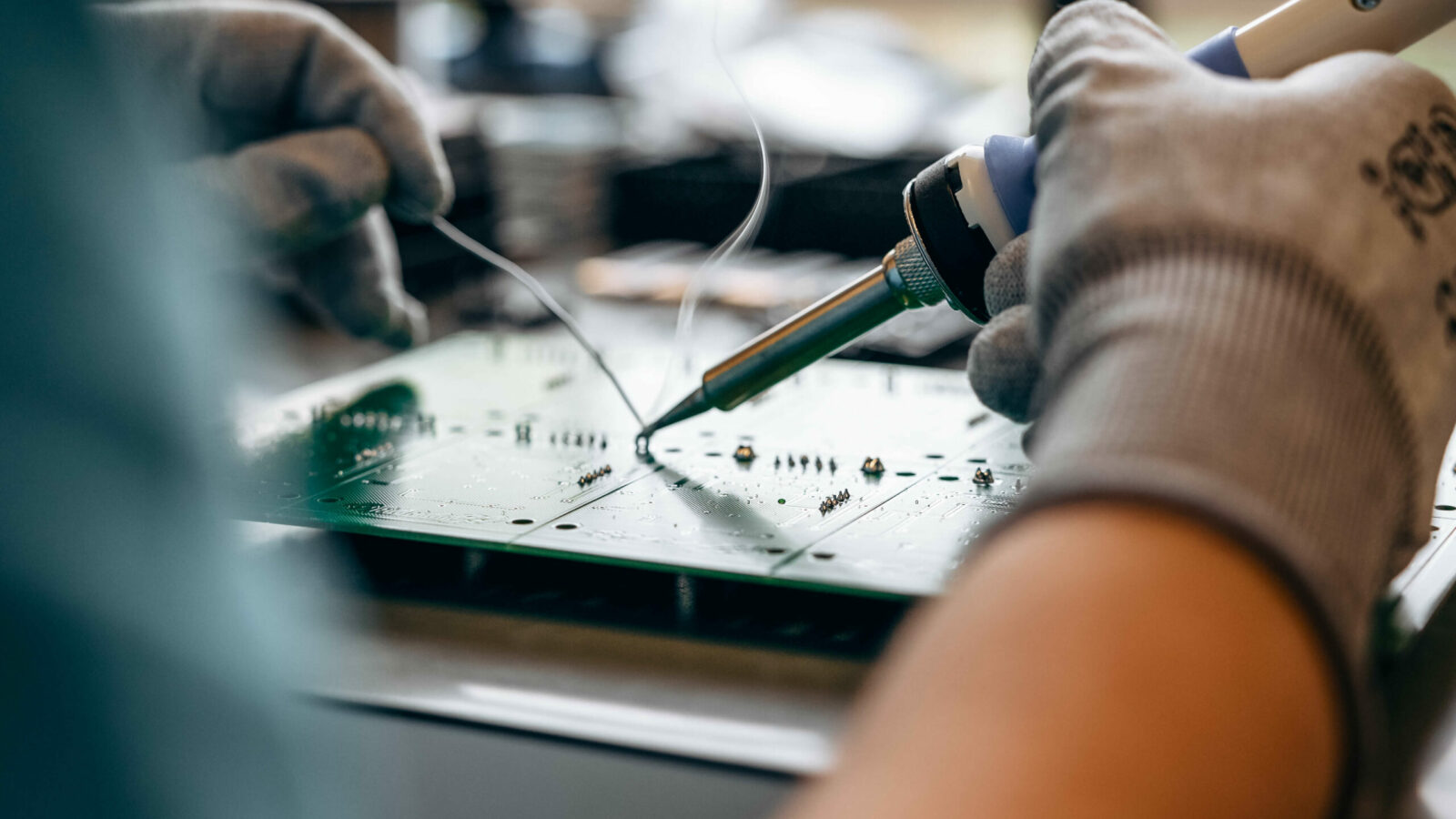
THT assembly is the part of electronics production that has not disappeared despite miniaturisation, and it will not. Connectors that someone will plug in thousands of times, transformers, high-capacitance capacitors, relays, screw terminal blocks: all of these need a joint that is mechanically stronger than solder on the surface of the board can give. At Convel we run through-hole assembly on an ERSA wave soldering machine, on an EBSO selective soldering system and by hand, at workstations staffed by operators with many years of experience. The choice of method depends on the project, not on which machine happens to be free.
What through-hole assembly is and when it is essential
In THT (Through-Hole Technology) the leads of a component pass through plated holes in the board and are soldered on its other side. The part is held by the laminate through its whole structure, not by the solder alone, which is why it withstands vibration, mechanical stress and high currents far better than its SMD equivalent.
In practice, THT assembly is needed wherever:
- a connector works under mechanical load: power sockets, industrial connectors, USB and RJ45 in portable devices,
- a component is heavy or tall: transformers, chokes, large electrolytic capacitors, heat sinks,
- high currents flow through the part: relays, terminal blocks, fuses,
- the device works in the presence of vibration: automotive, machinery, industrial automation,
- the design was created years ago and was simply drawn around through-hole parts.
A modern board is usually “SMD and THT” rather than “SMD or THT”: the microcontroller and the passive components in surface-mount technology, the connectors and power components through-hole. That is why we run SMD assembly and THT assembly in one hall, and the board moves between stages without leaving the plant.
Three THT soldering methods we use
Wave soldering (ERSA)
The board with its components inserted travels over a wave of molten solder, which wets all the leads on the solder side at once. This is the fastest method where there are many through-hole parts and for larger batches. It calls for a well-chosen flux, a preheating profile and protection of the SMD parts on the underside, if there are any there. We have this down, because we have been soldering on the ERSA wave for years.
Selective soldering (EBSO)
When a board carries densely packed SMD components on both sides and only a dozen or so through-hole parts, running the whole board over the wave would be risky. Selective soldering solders only the chosen points: a small solder nozzle comes up under specific leads while the rest of the board stays cold. For mixed SMD+THT devices this is now the most frequently chosen method, because it combines the repeatability of a machine with the precision that previously only manual assembly could give.
Manual assembly
Unusual parts, connectors with non-standard geometry, thermally sensitive components and short prototype runs are soldered by our operators. By hand we also fit displays, ribbon cables, keypads and parts that only reach the board during assembly into the enclosure. This is the same team that has worked on medical and industrial controllers for years, so “by hand” does not mean “less precisely”.
Mixed SMD + THT boards
The order is always the same: first the SMD line (solder paste printing, Yamaha pick&place, Heller reflow oven, AOI inspection), then the THT workstations. With the classic wave we protect SMD parts on the solder side with adhesive, or we plan the process so that there are none there. With selective soldering the problem disappears, because the solder touches only the indicated points. Which solution to use is settled while we analyse the documentation. Sometimes a single change in the design, for example moving a few SMD parts to the top side, makes a faster and cheaper method possible.
Mechanical assembly and non-standard jobs
THT assembly comes with operations that no machine will do: screwing on a heat sink, fitting spacers, plugging in an FFC cable, adding a module on a pin-header connector, conformal coating a section of the board. We carry them out at the same workstations, following the assembly instruction that we agree with the customer before the run starts. We treat non-standard jobs like any other: we describe the process, define the inspection, and start.
Quality control after THT assembly
After soldering, every board goes through a visual inspection of the joints: wetting, hole fill, cold joints, bridges, excess solder. Mixed boards have already been through AOI inspection after the SMD stage. The results are recorded in the production management system, and the ERP assigns to each batch the components it was built from. After THT assembly the board goes on to programming and functional testing, if the project calls for it.
What to prepare for a quotation
Besides the standard documentation (BOM, Gerber, pick&place file), THT assembly benefits from: an assembly drawing with the orientation of polarised parts, a list of the parts fitted by hand and information on whether the board has SMD components on the solder side. If you do not have this, we will prepare it together during the analysis of your documentation for production.
Frequently asked questions about THT assembly
What is THT assembly?
Through-hole assembly: the leads of a component pass through holes in the board and are soldered on the other side. It gives a mechanically stronger joint than surface-mount SMD assembly.
Wave or selective soldering – which to choose?
The classic wave where there are many through-hole parts and a simple solder side. Selective soldering for mixed boards with SMD components on both sides. Choosing the method is up to us and is part of the quotation.
Do you do THT assembly only, without SMD?
Yes. If you have boards with SMD assembly already done, or an entirely through-hole design, we will carry out THT assembly on its own, by hand or on the wave.
Do you fit unusual parts?
Yes. Connectors with unusual geometry, displays, ribbon cables, conformally coated parts and everything that needs hands rather than a machine are fitted by our operators, following the agreed instruction.
What batch sizes do you handle?
From prototype batches to series production. Manual assembly works well for short runs and the wave for large ones; we have a suitable method for every volume.
Ask about this service
Send us your project documentation and we will prepare a quote together with a proposed production schedule.
Request a quote View other services