
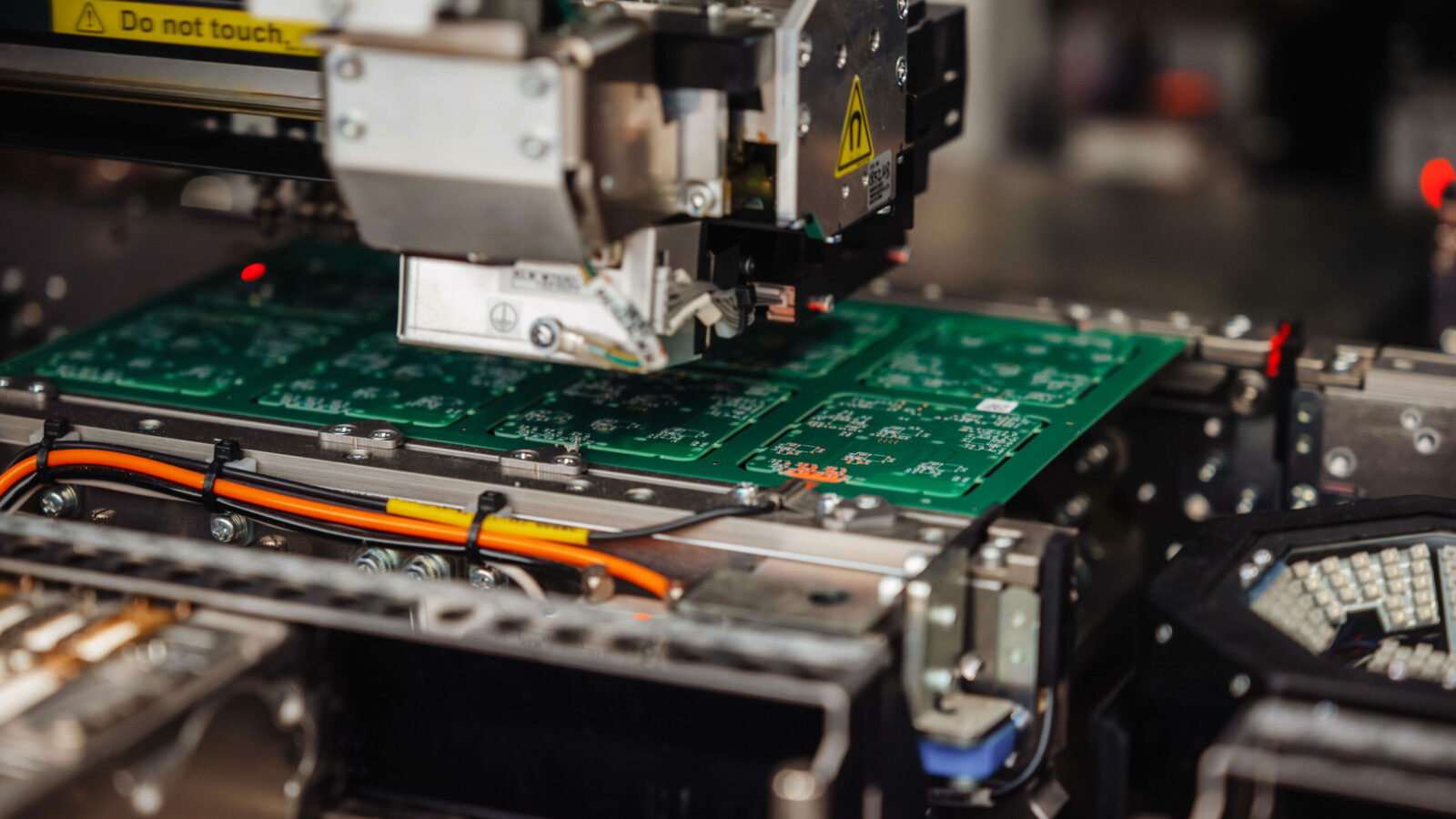
We have been doing SMD assembly at Convel for well over a decade exclusively on Yamaha pick&place machines. That is not an accidental choice: one machine platform means the process is repeatable whether you order 50 prototype boards or a run counted in tens of thousands. After assembly the boards go through automated optical inspection, and every batch has its history in our ERP system. Send us the BOM and the Gerber files and we will tell you what it costs and when you collect the finished boards.
SMD or SMT assembly – what is the difference
The two abbreviations are used interchangeably and in practice mean the same thing seen from two sides. SMT (Surface Mount Technology) is the technology: a method of assembly in which components are soldered directly onto pads on the surface of the board, without leads going through holes. SMD (Surface Mount Device) is a component made for that method: an 0402 resistor, a microcontroller in a QFN package, a memory chip in BGA. So when you ask about “SMD assembly” or “SMT assembly”, you are asking about the same service. We say “SMD assembly”, because that is what most of our customers say.
The alternative is THT through-hole assembly, which still has its place for connectors, transformers and parts exposed to vibration. Most modern devices combine both technologies on one board, which is why we run THT assembly on the same shop floor, a few metres from the SMD line. If you are looking for one supplier for the whole thing, from SMD through THT to enclosure assembly, see how we handle electronics assembly to order. If you want to understand the differences in more detail, we wrote about it separately: SMD or THT assembly.
How SMD assembly works at Convel, step by step
A board entering the line follows the same path regardless of order size. Only the changeover time and the number of feeders differ.
- Solder paste printing. A screen printer applies paste through a stencil precisely onto the solder pads. Most of the later joints depend on the quality of this step, which is why we prepare stencils for the specific design rather than using something “off the shelf”.
- Component placement. Yamaha pick&place machines take parts from tape, trays or tubes and place them on the board with a repeatability that cannot be achieved by hand. We place passives in 0402 and 0201 sizes and devices in QFN, QFP and BGA packages.
- Reflow soldering. The board travels through a Heller oven with a temperature profile matched to the paste, the laminate thickness and the mass of the components. The paste melts and forms the joints.
- Automated optical inspection. Every batch goes to AOI inspection on MEK/Marantz equipment, which compares the assembled board against a reference and catches missing parts, offsets, reversed polarity and solder defects. The inspection result is recorded in the production system.
- Further stages. If the design calls for it, the board goes on to THT assembly, programming, functional testing and final assembly. All under one roof, with no packing and shipping between subcontractors.
Machine park and technological capabilities
Our SMD lines are built on Yamaha, Heller and ERSA equipment, in a configuration that allows quick changeover between projects. For you that means specific things:
- high line throughput, so large runs are delivered in a predictable time and short ones do not wait in the queue for weeks;
- placement of small 0402 and 0201 passives and of BGA devices, that is everything modern electronics with radio modules, microcontrollers and memories requires;
- lead-free soldering in line with RoHS requirements, with an oven profile matched to each design;
- automated optical inspection after every batch as standard, not as a paid option;
- SMD and THT assembly and manual operations on the same shop floor, with no logistics between plants.
You can see the machine park with your own eyes. You are welcome at our plant at Kopijników 75A in Warsaw once a visit has been arranged. More about what we work on can be found on the about us page.
SMD assembly of small runs and prototypes
SMD assembly in small runs only makes economic sense when line changeover is quick. Ours is, because we have worked on one machine platform for years and we generate the pick&place programs from the design files rather than from scratch. That is why, alongside high-volume production, we take on prototype batches from a few units and pilot runs counted in tens or hundreds. We assemble prototypes on the same machines as production runs, not by hand, so the first board shows how the design will behave in production: whether the paste stencil needs a correction, whether some part has pads that are too small, where AOI raises false alarms.
The first unit of every new run goes through an additional check here before the rest of the batch is released. After the pilot run the customer knows how the device behaves and we know how the design behaves on the line, and only then do we set the series production schedule. If you are at this stage, read how to prepare a device for series production so you do not get stuck along the way.
We have no fixed minimum order quantity. What we do have is experience in when a small run pays off better than a large one and the other way round, and we say so when quoting, even if it means a smaller order.
What drives the price of SMD assembly
The question “how much does SMD assembly cost” only gets an honest answer once we have seen the documentation, but the components of the price are always the same. They are worth knowing, because you can influence most of them while the design is still open.
- Number and type of components. Assembly is priced in practice per solder joint and per component. 0201 parts, BGA devices and fine-pitch components need more precise paste printing and longer inspection, so they cost more than an 0603 resistor.
- One or two sides of the board. Double-sided assembly means two passes through the line and two oven profiles. Sometimes moving a few parts onto one side lowers the cost more than any negotiation.
- Run size and changeover. The paste stencil, the machine program and the AOI program are a fixed cost that weighs heavily at 20 units and disappears into the unit price at 5,000. That is why a prototype costs more per unit than a production run, and it will be so at any manufacturer.
- Component sourcing. Assembly from consigned material is cheaper as a service, but it requires process overage on your side and watching the deliveries. With sourcing by us you pay for the components and the logistics, and we take responsibility for production continuity.
- Panelisation. Small boards assembled individually cost more than the same boards in a panel. If the design has no panelisation, we will propose one at the documentation review stage.
- Tests and additional stages. Programming, functional testing, THT assembly and enclosure assembly are quoted separately, so you can see what you are paying for.
We break these components out in the quote, so you can compare it with other offers item by item, not just on the final figure. If any of them can be lowered by a change in the design, we say so in the quote.
Quality you can verify, not just take on trust
We do not rely on stamps, but on process. Every board goes through AOI inspection after SMD assembly, and the result goes into the production management system. The ERP system provides full traceability: for every batch we know which components it was built from, on which line, when, and who inspected it. If a component from a particular delivery turns out to be troublesome a year later, we can point to the boards it went into. In medical, automotive or gas detection that is not a luxury but a condition of working together.
What to prepare for an SMD assembly quote
We can quote fastest when we receive a complete set of documentation:
- the bill of materials (BOM) with manufacturer names and part numbers,
- the board production files (Gerber) and a pick&place file with component positions,
- assembly documentation: the assembly drawing, notes on polarity, parts fitted by hand,
- the planned run sizes and time frame.
Incomplete documentation is not an obstacle. We review it and suggest what to complete, and often what to change in order to lower the unit cost. It happens that swapping a single THT connector for an SMD version changes the quote more than negotiating the price would. If you also need component sourcing and PCB manufacturing, we will take that on and you will settle with one supplier.
Who we assemble for
Since 1991 our SMD lines have turned out, among other things, telematics modules and GPS trackers, devices with Bluetooth and Wi-Fi, boards for gas detectors, medical and industrial controllers, data loggers and automation equipment. We work regularly for companies in eight industries, from consumer electronics to control and security systems. Each of them has different requirements for documentation, testing and traceability, and we serve each of them with the same proven process.
SMD assembly in Warsaw, for companies across Poland and Europe
The SMD lines are at our plant at Kopijników 75A in Warsaw. For companies in and around Warsaw that means components can arrive in the morning and a prototype can be looked at in the afternoon, without a courier and without waiting. For customers further away, other things count: SMD assembly in Poland means short lead times, contact with a process engineer directly, no customs or clearance inside the EU, and the option to visit the shop floor when a new product goes into production. We ship finished boards and devices to any address in Poland and abroad.
Frequently asked questions about SMD assembly
What is the difference between SMD and SMT assembly?
Nothing in practice. SMT is the name of the surface-mount technology, SMD is the name of the components made for it. Both terms describe the same service.
What is the minimum order quantity?
We have no fixed MOQ. We handle prototype batches, pilot runs and high-volume production. The unit cost depends on batch size and we agree it when quoting.
Do you place 0201 parts and BGA devices?
Yes. The Yamaha machines place 0402 and 0201 passives and devices in BGA, QFN and QFP packages. Boards with such components go through AOI inspection as standard.
Do you supply the components for assembly?
Yes. You can supply your own components or have us source the BOM, including hard-to-find parts. We agree the model when quoting.
Can you do SMD and THT assembly on the same board?
Yes, that is the most common case. The board goes through the SMD line first, then the THT stations with wave or selective-wave soldering. All on one shop floor.
How much does SMD assembly cost?
It depends on the number and type of components, the number of board sides, the run size, panelisation and who sources the material. Once we have the BOM and the Gerber files we prepare a quote broken down into its components, so you know what you are paying for and what can be reduced.
Do you assemble SMD prototypes on the machines as well?
Yes. Prototypes and batches from a few units are assembled on the same Yamaha lines as production runs, so the first board shows how the design will behave in series production.
How long does it take?
It depends on component availability and run size. With complete documentation and components on site we turn prototype batches around quickly. We give a specific date in the quote and we keep to it.
Ask about this service
Send us your project documentation and we will prepare a quote together with a proposed production schedule.
Request a quote View other services