
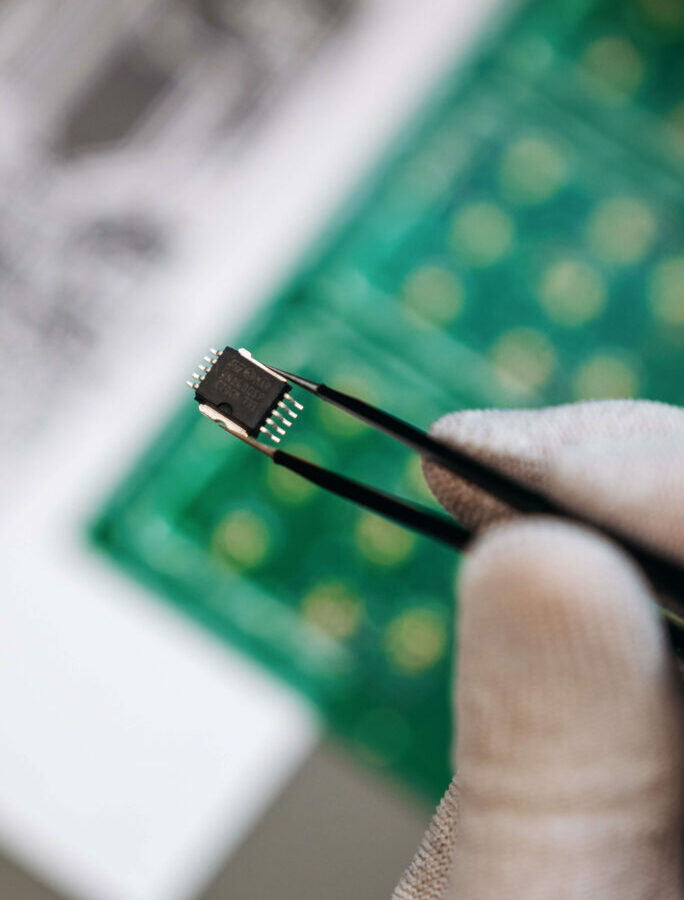
Most problems in electronics manufacturing do not start on the line, but earlier: in a design that worked on the bench but was not made with a pick&place machine, a reflow oven and a wave soldering machine in mind. This service exists to catch those problems before you order the first series. We analyse documentation and prototypes for series production, advise on component selection and propose design changes that lower the unit cost and improve reliability. And if you only have an idea, we will design the device from scratch. We describe the full design process on the electronic device design page; here we focus on what happens between a finished design and the start of production.
What DFM is and why the manufacturer does it
DFM (Design for Manufacturing) is a review of the design from the point of view of how it will be produced: whether it can be assembled automatically, tested and put together in a reasonable time and for reasonable money. A design house looks at the schematic and the functions. We look at the same thing, but from the shop floor: we know our Yamaha placement machines, the Heller reflow profile, the limits of the ERSA wave and EBSO selective soldering machines, and how boards with 0201 parts and BGAs behave in our process. That is why a DFM review at the manufacturer catches things the designer had no way of seeing.
What we check in the documentation
- Assembly technology. The share of SMD and THT parts, through-hole parts on the SMD component side, the option of replacing THT connectors with SMD versions to shorten the process and lower the cost.
- Printed circuit board. The size and shape of the pads, clearances, fiducials, panelisation for our lines, laminate thickness, pad finish matched to the planned soldering process.
- Components. Availability and alternatives, parts with long lead times, components going end of life, consistency of the BOM designations with what is actually meant to go on the board.
- Testability. Test points, access to the programming connector, the option of building a sensible functional testing procedure without taking the device apart.
- Final assembly. Fit of the board in the enclosure, cable routing, mounting of displays and keypads, labels and serial numbers.
You get the result of the review as a list of specific comments, split into those that have to be changed and those that are worth changing. The decision is yours, but every item comes with a cost or quality justification.
Unit cost optimisation
The changes we propose most often after a review are not spectacular, but they work: swapping a through-hole connector for an SMD one, standardising resistor values to reduce the number of feeders, moving a few parts to one side of the board, choosing component packages suited to automatic placement, designing the panel so that more boards fit on the line at once. Each of them is a few per cent of the assembly cost, and together they can change the quotation more than negotiation can. We write more about the typical pitfalls in the article from prototype to series production.
Support when production is started
The review is only the beginning. When a series is launched, we prepare the assembly documentation, the instructions for the manual workstations, the AOI inspection programme and the test procedure together with you. We treat the first batch as a pilot run: we check how the design behaves in the process, make corrections and only then move to series production. The customer gets a device that not only works, but can be produced repeatably.
Design from scratch
If you are starting from an idea or a specification, our design team will take you through requirements analysis, PCB design, embedded software (firmware) on the STM32, AVR, Nordic and ESP32 platforms, technical documentation and the start of production. The advantage of designing at the manufacturer is that from day one the design is created for a specific assembly process, and not for “some factory”. We describe the details on the electronic device design page.
Frequently asked questions about design support
I have a finished design from an outside design house. Does a DFM review make sense?
Yes, and in that case especially. A design created outside manufacturing usually does not take the constraints of a particular assembly process into account. The review catches them before you order boards and components.
Is the review chargeable?
The basic documentation review is part of the assembly quotation. Deeper design work, for example redesigning the board, we quote separately once the scope is agreed.
Will you take over production of a device that someone else makes today?
Yes. We analyse the documentation and, where possible, one unit of the device, tell you what needs to be completed, and run a pilot run before taking over production.
How long does the review take?
With complete documentation, usually a few working days. We confirm the date once we receive the files.
Ask about this service
Send us your project documentation and we will prepare a quote together with a proposed production schedule.
Request a quote View other services